Duck farming

Ducks need water, and lots of it, to live healthy and happy lives. Yet ducks on Australian farms — both factory farms and free range — are being left high and dry.

shadow

Like a duck to water...

The single most shocking, and arguably the most significant welfare concern for duck farming in Australia is water deprivation. There is no legal requirement in Australia for commercial duck farms to have water available for ducks to swim, bathe, or even dip their heads.Like a duck out of water: an exposé of the Australian duck industry'. Report by Animal Liberation NSW.

For most of us, ducks evoke images of an easy-going life, free to fly and paddle around a lake or wetland. But local and international export demands for down and feather products, meat and offal, is seeing more and more of these intelligent, social birds living short and miserable lives on commercial duck farms.

Like 'meat' chickens, laying hens and turkeys, who have all fallen victim to factory farming, ducks also suffer under these inherently cruel conditions — such as intense and crowded confinement, and routine surgical mutilations.

But, ducks also have a very specific need that most farms (including free range) are unlikely to meet — ducks need water. And lots of it.

Water deprivation

The saying 'like a duck to water' isn't just a catchy phrase: with their webbed feet, and ungainly gait on land, ducks are most definitely aquatic animals. Unlike other waterfowl such as geese and swans, ducks frequently dive underwater to feed on aquatic plants, insects, small fish and crustaceans. Perfectly adapted to a life in and on the water, ducks have evolved a tooth and bristle system that allows them to catch mouthfuls of food and filter out the water — just like a whale!

Sadly, this need for water leaves ducks especially vulnerable to suffering on commercial farms. Feeding and drinking water equipment specifically designed for ducks is not readily available in Australia.[1] So many duck farms use equipment designed for intensively farmed chickens: tiny drip feeders that don't allow ducks to bathe or clean themselves, let alone swim.

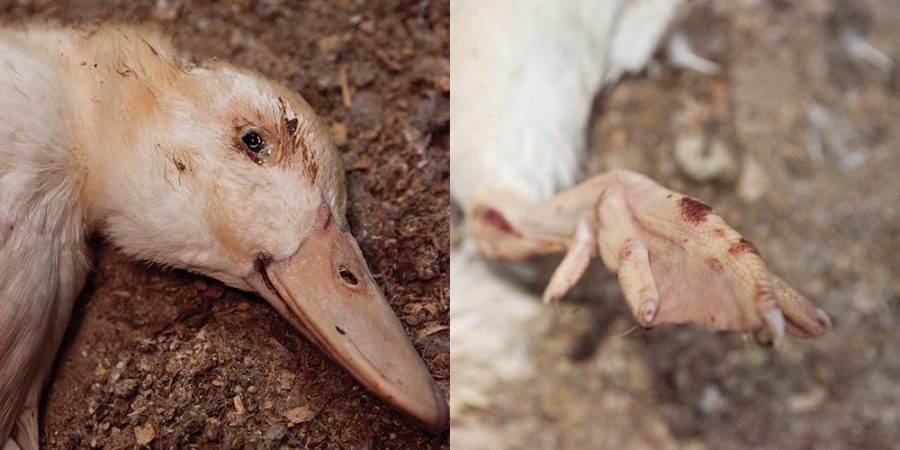
This duckling was found trapped in a pile of faeces in a shed in Victoria. Most farmed ducks live their entire lives in sheds that won't be cleaned until they're sent to slaughter. Photo: Tamara Kenneally.

Without access to adequate supplies of water to clean themselves, and take the weight off their joints (which are designed to be buoyed in water most of the time), ducks are particularly susceptible to heat stress, respiratory illnesses, wounds, crusty eyes that can lead to blindness, and dislocated or broken limbs.

European welfare standards recognise that farmed ducks must be provided with sufficient water for hygiene and swimming.[2] Most duck farms in Australia are sadly failing to deliver even this most basic welfare requirement for ducks.

What about free range?

While ducks in factory farms are denied one of their most fundamental needs — adequate access to water to bathe — on this most critical point, it's questionable that life for ducks on most free range farms is much better.

Investigations into several 'free range' duck farms in Victoria have found ducks living in factory farm-like conditions, without access to water to bathe or clean themselves.

In fact, neither of the largest free range accreditation bodies in Australia — Free Range Egg & Poultry Australia (FREPA) and Humane Choice — require farms to provide ducks with adequate water to bathe freely.

Most ducklings are denied access to pools or troughs of water, so are unable to  regulate their temperature, take weight off their swollen legs or clean themselves. Photo: Tamara Kenneally.

There's no doubt that Australians are growing increasingly concerned about cruel farming practices. Fighting back against the cruelty of factory farming, some concerned shoppers are choosing to reduce their meat-consumption or go meat-free, and others are looking out for terms they believe mean animals aren't confined in factory farms. But what do the labels 'free range' and 'organic' really mean for farmed ducks? Discover for yourself in the chart below...

Duck labels explained

Certification systems included in the table below:

70-FREPA_logo.jpg Free Range Egg and Poultry Association (FREPA)
70-humanechoice-logo.jpg Humane Choice 'Certified organic'
70-ACO-logo.jpgAustralian Certified Organic (ACO)

Note: If the production system isn't specified on the packaging, the duck almost certainly lived her life in a factory farm. PoultryHub estimates that approximately 8 million ducks are slaughtered for food each year in Australia. The vast majority of these ducks live in factory farms owned by the two major duck-meat producers — Pepe's Ducks and Luv-a-Duck. Only a very small number of ducks raised for meat in Australia live their lives on free range or organic farms.

1000-ducks-explained-chart-header.jpg?1

Factory farmed Accredited Free Range Egg and Poultry Association
Accredited Free range
Humane Choice


Australian Certified Organic
(ACO)
Do ducks have access to an outdoor range? NO YES YES YES
Are ducks' beaks cut? YES MAYBE
NO MAYBE
How many ducks are kept (per square metre) when in sheds? Up to 8
Up to 10
(+ access to outdoors)
2 Up to 8
(+ access to outdoors)
Are ducks provided with enough water to clean themselves and perform natural behaviours? NO NO NO YES
Can ducks be exposed to periods of artificial light to induce weight gain? YES
(up to 20 hours per day)
YES
(no limit)
YES
(up to 16 hours per day)
YES
(up to 16 hours per day)
Are ducks routinely bred for unnaturally fast growth? YES YES YES PROBABLY
Are ducks sent to slaughter from seven weeks of age? YES YES YES YES

Print or download this chart

A note on 'free range': Unfortunately there is no legal definition of 'free range' in Australia so standards between farms can vary. While the two largest free range accreditation bodies — FREPA and Humane Choice — require ducks to be given access to an outdoor space, neither of them explicitly require the provision of sufficient water pools, streams or troughs for swimming and cleaning: the lack of which constitutes the single greatest welfare concern for ducks.

A note on 'organic': While Australian 'Certified organic' (ACO) ducks are kept on farms which generally meet or exceed the standards of free range facilities, it should be noted that the word 'organic' on its own (i.e. without the word 'certified') can sometimes mislead people into thinking the welfare of ducks meets certified organic welfare standards — when in reality it may simply mean that ducks are raised on organic feed.

Click here for added details on the Ducks Explained labelling guide »

Toxic environment

Most ducks sheds are not cleaned for the entire time ducks live in there. Without access to pools of clean water for bathing and exercise, ducks can quickly succumb to a range of debilitating medical conditions. Unable to clean a toxic build-up of ammonia-rich excrement off themselves, ducks in these sheds are frequently afflicted by ammonia-related conditions such as chemical burns, respiratory infections and footpad lesions.[3]

Wounds and disease

Ducks have very delicate feet, and are prone to abrasions and injuries when forced to walk on the rough floors inside sheds. The resulting wounds leave them highly susceptible to a range of infections.

The most common infection afflicting ducks on commercial farms is a blood disorder called anatipestifer disease. Ducks who contract this disease can suffer from diarrhoea, tremors, trouble breathing, paralysis, convulsions and death. In most affected flocks, an average of 5% - 30% of birds will die from the disease, but in some instances up to 75% of birds may die. The cramped and dirty conditions of sheds on many duck farms provide the ideal environment for disease to spread, through small cuts and scrapes on ducklings' sensitive feet.

It is my professional opinion that birds with these clinical signs [of anatipestifer disease] would be suffering extreme pain and discomfort...Dr Mark Simpson, BVSc MANZCVSc (Avian Health) CMAVA
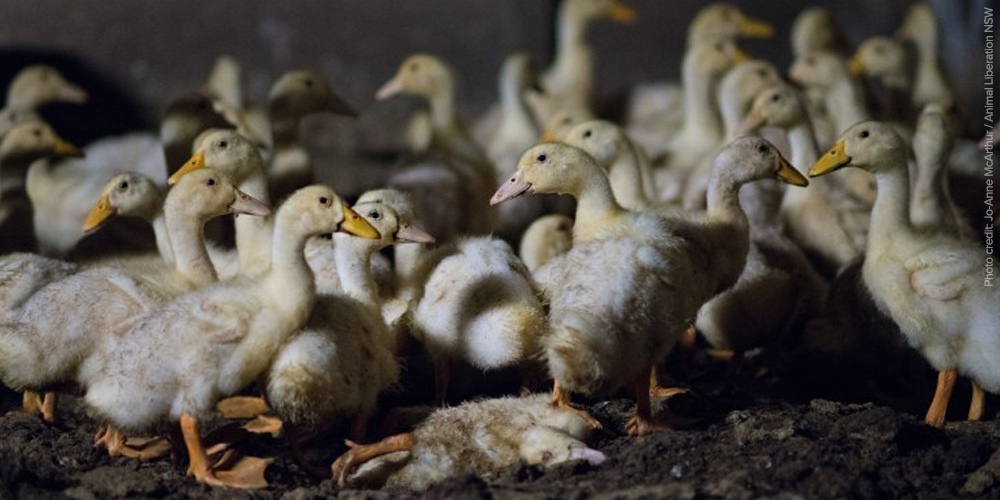
[4] Severe overcrowding in sheds can contribute to heightened stress levels and the transmission of infectious diseases. Photo: Investigation still from a Victorian duck farm.

Selective breeding

Ducks who have been selectively bred for fast weight gain to meet 'production demand' experience extraordinary pressure on their heart, lungs and legs. This can result in difficulty breathing and standing up, joint pain, dislocations and fractures. A condition called Ascites — in which ducks are variously affected by hypertension, suffocation on their own internal fluids, or sudden death — is also a 'side-effect' of selectively breeding animals to grow unnaturally fast.[5]

Beak cutting

A duck's bill is full of nerves, to help her feel around. Yet many ducks raised in Australia have the sensitive tips of their bills and nails cut off without pain relief. This is done for the same reason battery hens face this cruel procedure: to prevent injuries if they peck each other — a common behaviour resulting from severe stress and close confinement. In some instances this mutilation can result in life-long pain.[6]

Breeding violence

In the wild, female ducks can escape from particularly aggressive males. But in commercial breeding sheds, female ducks can suffer injuries during "mass matings".[7] The resulting wounds can become infected in filthy uncleaned sheds — with the afflicted female 'breeder' ducks then being forced to live with potentially debilitating injuries for up to 16 months before being sent to slaughter.[8]

Maternal instincts

Ducks are doting mothers and will generally look after their small broods for up to eight weeks, until they're strong enough to make it in the world alone — but farmed ducklings never get to meet their mother, and are sent to slaughter when they're around seven weeks old.

Ducks on commercial farms are denied the ability to express their maternal instincts. These 'breeder' ducks are also confined to factory farm-like sheds. Living under long hours of artificial lighting, they are forced to breed almost all year-round. They produce up to 100 eggs a year, and all of them are taken away as soon as they are laid. This unnatural and intense laying cycle can lead to female ducks suffering painful health problems with their reproductive organs.[9]

Balut

Balut is a restaurant dish consisting of an egg with a developing duck embryo inside. This developing duckling is boiled alive inside the egg and then eaten. Some ducklings are eaten at 12 days old, when they have soft bones, while others are eaten once their beaks and feathers have begun to develop. At least one free range duck farm in Victoria is known to have sold this product.

These ducklings are still covered in their soft, yellow infant down. They'll be shipped off to slaughter at around 7 weeks old, before they've even developed the white feathers of adult ducks. Photo: Tamara Kenneally.

Rough handling

Ducks who are farmed are often roughly handled — groups of young ducklings, for example, may be grabbed and even picked up by their necks.[10]

While the government recommends that only trained workers should be allowed to handle ducks,[11] no duck handling training is currently legally required on duck farms in Australia.

Slaughter

Ducks in the wild can live anywhere from 5-20 years, but most farmed ducks are killed at just 7 weeks of age.

At the slaughterhouse, these young ducks are shackled by their legs and hung upside down. This puts immense strain on their weak leg joints, and can even result in dislocation. Their heads are then dunked into a tank of electrified water to stun them, before their throats are cut.[12] But ducks don't always have their heads fully immersed in the electrified water, and these unfortunate birds can have their throat cut whilst still fully conscious.[13]

Sadly, wherever animals are handled or slaughtered en masse, there will be fear and suffering. This is the reality of raising and killing animals for food. But you have the power to take a stand against this cruelty.

shadow

You can help

The great news is that it couldn't be easier for you to protect ducks!

  • Ducks are thinking, feeling animals with their own desires and needs. Most fundamentally, they need a lot of water — and few commercial duck farms (including free range) adequately meet this most critical requirement. You can take a stand against the cruelty of commercial duck farming at every meal, by choosing to take duck products off your plate.
  • If you're ready to make the ultimate choice for animals, start exploring a world of delicious cruelty-free food and meat-free alternatives today!
  • Commercial duck farms aren't the only place ducks are in danger — every year hundreds of thousands of native water birds are wounded and killed during recreational duck shooting seasons in Victoria, Tasmania, the Northern Territory and South Australia. Add your voice to the call for an end to duck shooting today!
shadow

Many thanks to Animal Liberation NSW, whose numerous investigations, and comprehensive report ‘Like a duck out of water: an exposé of the Australian duck industry’, has provided Australians with an insight into the lives led by ducks on commercial farms.

Many thanks also to Tamara Kenneally, whose photography is doing so much to bring to light the plight of individual animals in the food and entertainment industries.

shadow

References

[1] Animal Liberation NSW, 'Like a duck out of water: an exposé of the Australian duck industry', 2013. Retrieved from: http://www.aussieducks.com.au/report

[2] VIVA! USA, 'Ducks out of water: a report on the duck industry in the USA'. Retrieved from: http://www.vivausa.org/campaigns/ducks/duckreport01.htm

[3] The Humane Society of the United States, 'An HSUS Report: The welfare of animals in the duck industry'. Retrieved from: http://www.humanesociety.org/assets/pdfs/farm/hsus-the-welfare-of-animals-in-the-duck-industry.pdf

[4] (On examination of Animal Liberation NSWs video footage of ducks within total confinement farming facilities such as those used by major Australian duck producers.) Animal Liberation NSW, 'Like a duck out of water: an exposé of the Australian duck industry', 2013. Retrieved from: http://www.aussieducks.com.au/report

[5] Rob Porter, D.V.M., Ph.D., DACVP, DACPV, Diseases of Small Poultry Flocks, 2003. Retrieved from: http://www.poultryu.umn.edu/

[6] VIVA! UK, Ducks out of Water: A report on the UK duck industry. Retrieved from: http://www.viva.org.uk/ducks-out-water-report-uk-duck-industry

[7] New South Wales Department of Primary Industries, Agriculture duck breeds and breeding. Retrieved 20th August, 2014 from: http://www.dpi.nsw.gov.au/agriculture/livestock/poultry/species/duck-raising/breeds-and-breeding

[8] Animal Liberation NSW, 'Like a duck out of water: an exposé of the Australian duck industry', 2013. Retrieved from: http://www.aussieducks.com.au/report

[9] Animal Liberation NSW, 'Like a duck out of water: an exposé of the Australian duck industry', 2013. Retrieved from: http://www.aussieducks.com.au/report

[10] Primary Industries Standing Committee, The Australian Code of Animal Welfare Practice, Domestic Poultry 4th Edition. Retrieved from: http://www.publish.csiro.au/pid/3451.htm

[11] Primary Industries Standing Committee, The Australian Code of Animal Welfare Practice, Domestic Poultry 4th Edition. Retrieved from: http://www.publish.csiro.au/pid/3451.htm

[12] Animal Liberation NSW, 'Like a duck out of water: an exposé of the Australian duck industry', 2013. Retrieved from: http://www.aussieducks.com.au/report

[13] The Humane Society of the United States, 'An HSUS Report: The welfare of animals in the duck industry'. Retrieved from: http://www.humanesociety.org/assets/pdfs/farm/hsus-the-welfare-of-animals-in-the-duck-industry.pdf


Love animals? Subscribe and help end animal abuse:
Like Animals Australia On Facebook
UP NEXT...
Despite the nightly news doing its best to depress, from Australia to Brazil, China to Norway, there is one trait that unites humankind all over the world — kindness. Read on to discover some of the best animal... Watch the viral video » »

In a glorious tribute to the power of compassion, the Gadhimai slaughter festival will now be a "momentous celebration of life." Celebrate the great news » »

The repercussions of our investigations into the greyhound racing industry have been game-changing. Here's how you helped make a difference. Read the latest » »

In response to the exposure of hidden abuse of greyhounds sent to SE Asia, the flying Kangaroo has vowed to not support this cruel export trade. Read the good news » »

One of the world's foremost spiritual leaders has used his influence to speak out in defence of all those who share this planet. Read more » »

What contributes more to climate change than all the world’s planes, trains and automobiles combined? Hint: it’s not coal and it’s not good for humanity! Read more » »

No chickens were harmed in the making of this video. Or this meal. Read more » »

For the first time, an Australian organisation has been selected as a “standout charity” by U.S.-based Animal Charity Evaluators! Animals Australia has been awarded this evaluation in recognition of our efforts... Read more » »

In 2014, Lyn White, Campaign Director at Animals Australia, spoke to audiences across the country — and asked one simple question: 'Does history have to repeat itself or is it possible to have a kinder, m... Watch now » »

You already know cage eggs are cruel, but you'll never hear the cage egg industry admit it. So what else might they be cagey about? These five facts may ruffle some feathers. Discover the truth » »

Make a difference for animals...

www.animalsaustralia.org