These are the logos and terms behind the certification schemes outlined in the above table. It’s not an exhaustive list of the brands behind egg products but instead a snapshot of some of the most common accreditation labels you’re likely to see in the supermarket.
‘RSPCA Approved’
The RSPCA Approved farming system accredits egg farms to RSPCA standards. Barn-laid eggs can be RSPCA Approved, therefore not all RSPCA Approved farms allow hens access to an outdoor area. The description ‘barn laid’, ‘free range’ or ‘outdoor’ on RSPCA Approved egg cartons will indicate if the hens had access to the outdoors or were confined indoors (barn laid).

‘Free Range’
Conditions in free-range egg farms can vary dramatically. Smaller-scale producers might stick to the 1,500 birds per hectare as the guidelines recommend, but regulations endorsed in 2018 allow farmers to keep up to 10,000 birds per hectare and still label their eggs as ‘free range’. Check the egg carton for the stocking density, which must be clearly printed.
Along with RSPCA Approved free-range eggs, this logo also indicates that the eggs have come from hens raised on a true free-range farm.

‘Certified Organic’
Certified organic eggs come from hens kept on farms that meet or exceed the standards of the best free range facilities. However, simply the word ‘organic’ on an egg carton can sometimes mislead people to think the welfare of hens meets certified organic standards, when it may merely mean that hens in barns are fed organic grains.
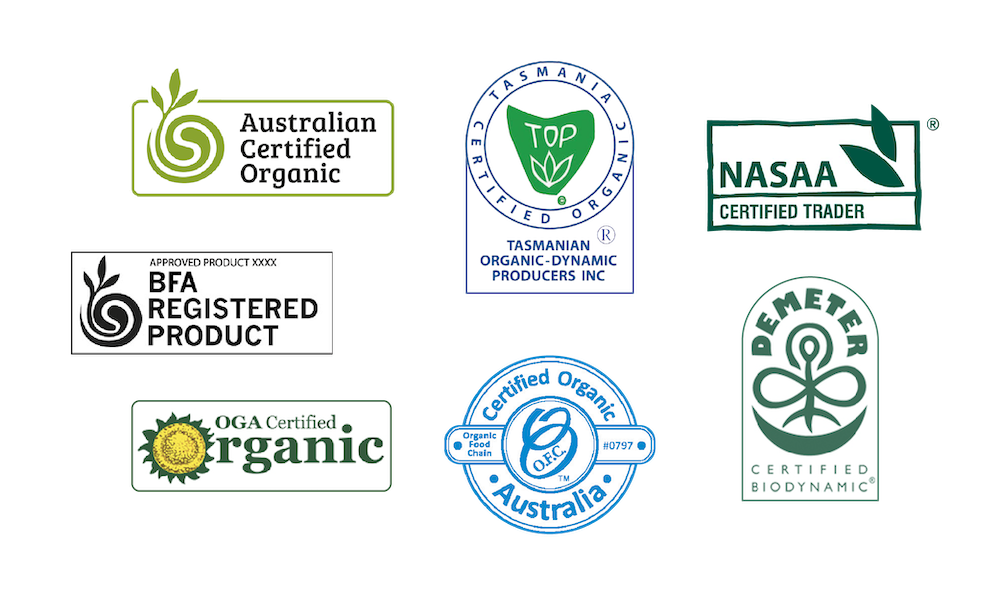
These are some of the logos that indicate that the hens are raised on a certified organic farm.
‘Barn laid’ or ‘Cage free’
Hens in barn-laid housing systems are not confined in cages, so they can move around — but high stocking densities can restrict their ability to move freely and exercise. Being confined indoors also restricts their freedom to express natural behaviours that provide them with a life worth living. Barn-laid eggs may also be labelled as ‘cage-free’.
Other claims on egg cartons
There are many other marketing terms used on egg cartons to imply higher welfare. These labels should be read discerningly. Terms such as ‘Vegetarian’, ‘Eco eggs’ and ‘Omega 3 eggs’, for example, are not recognised descriptors of the type of housing system or a level of welfare for hens.
The term ‘Cage-free’ is also regularly used, but it is important to note that these hens are raised in barns and do not have access to the outdoors.
Likewise, don’t be misled by clever imagery — some cartons may depict birds sitting on nests, or in green rolling fields, but unless accompanied by an accreditation label, these images are most likely inaccurate.