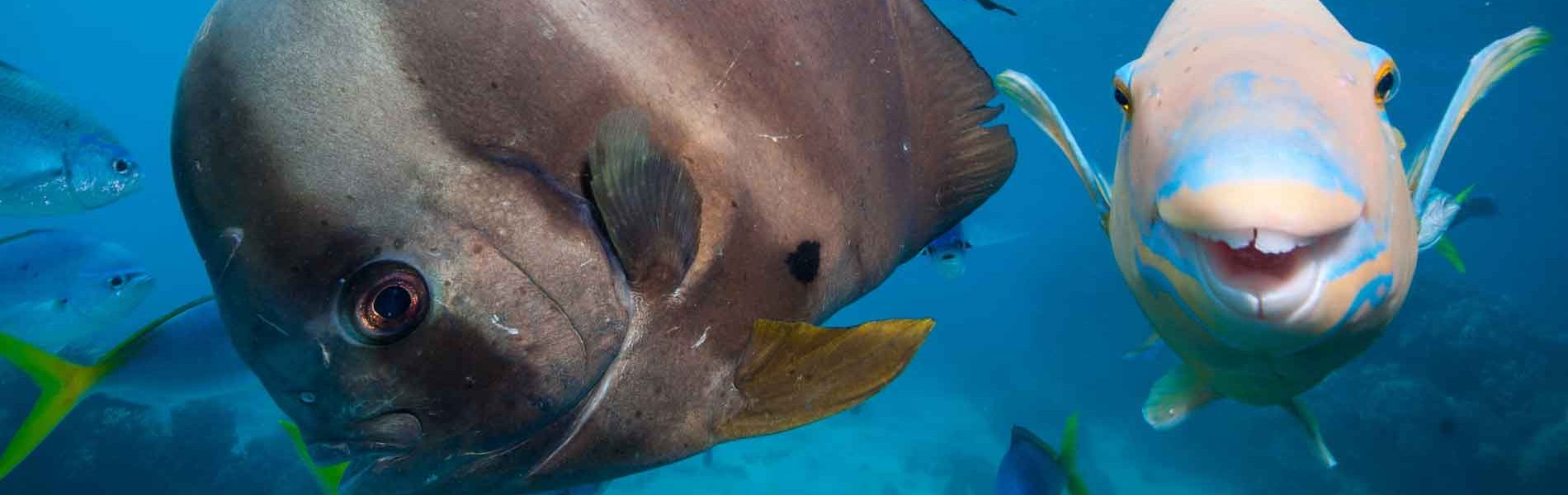

A parrot fish and bat fish together in a reef – the parrot fish is almost cartoon-like, seemingly smiling at the camera.

9 facts about fish and other marine animals to share far and wide.

There are many misconceptions about fish floating around. These fascinating facts will likely change the way you view sea animals forever!

Animals Australia

Animals Australia team

Last updated August 24, 2023

Life for a fish might seem simple at first glance, but much like the oceans they call home, there are untold depths beneath the surface.

We still have so much to learn about marine animals and how they experience their watery world – but already there is an exciting body of scientific evidence revealing them to be inquisitive, intelligent, and emotionally complex individuals.  

Keep reading for some fascinating facts that will make you see why fish and other marine animals belong in the sea (instead of on the dinner table!).
1. They are forward-thinking and resourceful

Fish have been shown to outperform even monkeys, chimps, and orangutans on complex foraging tasks, demonstrating their remarkable capacity for planning and problem-solving. 

In fact, their learning abilities are far more sophisticated than most people realise – they can even use tools. This is particularly significant when you consider that tool use was once thought to be exclusive to humans. 

For example, blackspot tuskfish have cracked the case when it comes to opening up molluscs to eat – they hit them against rocks to pop them open. And what’s more, many of them do so the exact same way, which scientists believe could point to this being a skill that generations of parent tuskfish have passed down to their offspring.  

Aptly named archerfish also have a knack for using what’s in their environment to hunt for food that’s out of reach. They have the mental ability to predict where an insect is going to be above the water, and shoot at them with mathematically aimed streams of water! 

In contrast, some kinds of fish are talented gatherers, tending well-kept gardens by encouraging the growth of algae they enjoy, and weeding out the kinds they don’t like as much. Who knew fish could have such green thumbs fins?

2. They’re innovative architects and artists

Octopuses have been spotted building barricades out of rocks, and carrying large shells around with them, just in case they need a portable shelter to hide in. 

Many species of fish build extra-secure nests by creating chambers under the seabed and reinforcing them with pieces of coral. They can spend hours moving mouthfuls of sand and algae around to make their new home as perfect as it can be. A fish might even steal someone else’s nest if it looks more comfy than theirs – so not only are they smart, they can be a little cheeky too. 

Some fish, like the Japanese pufferfish, have a real flair for design and will go to extraordinary lengths to attract a mate to their nest, spending not just hours but days on end creating elaborate sand art and decorating it with scavenged shells. Check out this surreal labour of love:

3. They are self-aware

Ever heard of the mirror self-recognition test? It’s a scientific way of testing whether an animal has self-awareness, and it involves placing a coloured mark somewhere on the animal’s body, and letting them look in a mirror. 

If the animal sees the mark in their reflection, then attempts to find and touch the mark on their own body, they pass the test – proving that they have recognised themselves in the mirror and have a sense of self and their own body.  

It probably won’t surprise you to hear that some of the species who have passed this test with flying colours include chimpanzees, orangutans, elephants, and dolphins … but so have fish! 

The fact that fish demonstrate this advanced act of cognitive awareness is just further proof that they’re far more perceptive than they get credit for. How’s that for something to reflect on?

4. They have unique ways of experiencing the world

Some of the ways marine animals perceive the world are so amazing that they’re almost incomprehensible. We’re about to hit you with a mind-blowing example… 

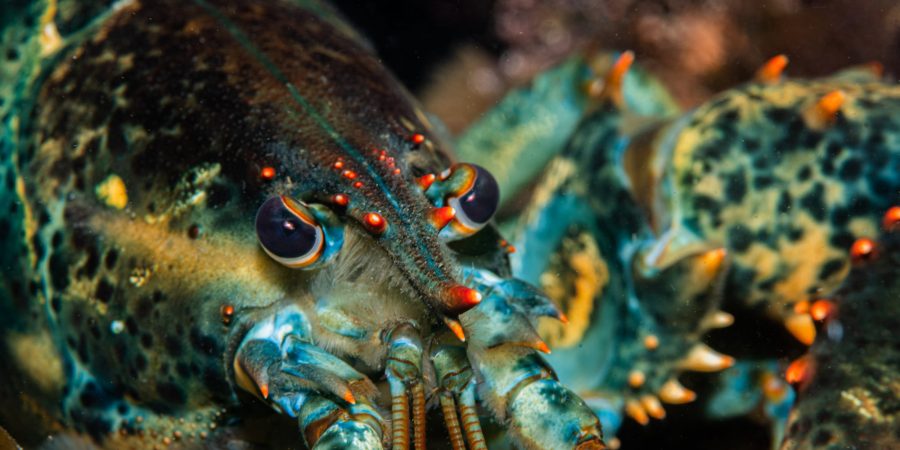
Lobsters’ feet smell.  

No, not like that! Lobsters actually smell with their feet – they’re covered with tiny, super-sensitive hairs, making them so finely attuned to smells and tastes that they can sniff out a single amino acid originating from their favourite food.  

Studies have also found that crustaceans can see polarised light, which we certainly can’t. This superior form of vision allows them to navigate better underwater, track transparent or silver prey, and avoid predators. 

This image contains content which some may find confronting

A close up of a lobster – they are blue with some yellow and orange markings, and have expressive, attentive eyes.

5. They can feel pain and distress

Just as fish can experience happiness and pleasure, so too can they feel suffering and pain. 

Studies have shown that fish have pain pathways that are very anatomically similar to those of humans and other mammals, including nerve endings, chemical neurotransmitters, and a brain structure that allows the processing of pain signals. 

The scientific consensus is that other sea-dwelling animals like lobsters, octopuses, prawns, and crabs feel pain and distress, too. In fact, in 2021, they were officially recognised as ‘sentient’ by UK law – meaning that they are aware, feeling, and sensitive. 

Lobsters are particularly vulnerable because they cannot go into a state of shock like we (and many other animals) can, as a coping mechanism for pain. Sadly, this means that when they are dismembered or boiled alive, their suffering is extreme and prolonged.

6. They’re emotional beings who love to play

Our aquatic friends may not express themselves in ways we recognise as easily as other animals, but there is a soft side beneath those scales and shells! Fish and marine animals have rich inner emotional and social lives.

According to the latest scientific research, they are capable of feeling a range of positive emotions like pleasure, excitement, and joy, just as much as any other animal – as well as the desire to play.  

It may sound like something out of Finding Nemo, but some scientific studies have observed fish riding bubble streams and toying with objects in their environment, for no other reason than to amuse themselves and have fun!

This image contains content which some may find confronting

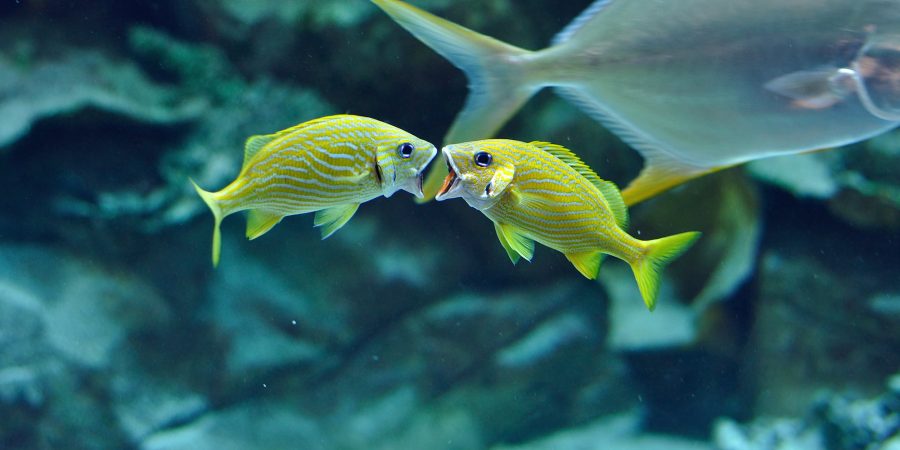
Two Blue stripe grunts facing one another in the water, their mouths wide open.

7. They have amazing memories

Something’s fishy about that whole ‘3-second memory’ thing … Many marine animals actually have great long-term memories! 

Octopuses have demonstrated comparable memory abilities to some vertebrates, cuttlefish can reminisce about their favourite meals – and perhaps the most impressive example is that even after several years, a salmon can still follow her nose home, because she remembers the exact smell of the stream in which she was born.  

All the evidence shows that fish can learn from each other, retain detailed mental maps of their surroundings, know their place in social hierarchies, and remember other fish they’ve spent time with previously. In fact, not only can fish differentiate between individuals of their own species, they can also recognise and remember human faces! 

Just check out this heart-warming story about a diver who realised that a wild fish he kept seeing actually recognised him and wanted to be friends, seeking him out time and time again to hang out: 

8. They communicate with each other and foster deep social bonds

Fish may seem like the silent type, but the reality is that they’re actually pretty chatty – we mere humans just can’t hear them unless we use special instruments. Typically, fish talk to each other using chirps, squeaks, ‘foghorn’ noises, and other low-frequency sounds that our ears are not attuned to.  

This shared language, as well as silent forms of communication like gestures and motion, helps them establish and navigate intricate social networks – by cooperating with their peers and forming lasting friendships with individuals.  

Some fish pair off with a particular friend whenever they go foraging (like doing their grocery shopping together!) and others have even been known to signal to and cooperate with other species, like eels, while hunting for food.  

They may be altruistic, too. Tiny fish, for example, will often clean inside the mouths of larger fish, and the larger fish return the favour by not eating them. But this goes beyond just ‘you scratch my back, I’ll scratch yours’ … When under attack, the larger fish will sometimes spend crucial moments waiting for the tiny fish to leave their mouths before they flee – endangering their own lives to avoid accidentally swallowing their friends. 

There’s even an incredible video of a puffer fish refusing to leave her stuck best friend’s side until they are rescued. It seems the desire to protect our friends is universal.

9. They are individuals with their own quirks and personalities!

Research has shown that some fish tend to be bolder, more social, and more eager to explore the world around them – whereas others are more shy and less likely to take risks. 

Just like us, the personality traits a fish expresses depend on both their life experience, and the genes they inherit from their parents. And their individual personalities can be surprisingly complex! 

They all have one thing in common…

They are animals who are worthy of care and protection – yet these individuals are too often overlooked as seemingly silent victims of our current food system.  

Thankfully, the tide of compassion is turning! More and more caring people are choosing to leave marine life off their plates and in the sea where they belong. And these days, it’s all too easy to enjoy kinder takes on popular dishes from ‘fish’ and chips to ‘tuna’ sandwiches.

If you’re ready to dive into ocean-friendly eating right away, check out our favourite recipes – or grab your free Veg Starter Kit below. No need to shell out, it’s completely free! Water you waiting for? 

Order your free guide today. Nearly there! Thank you ! Thank you!

, tell us where to send your free guide tell us where to send your free guide Thank you for helping pave the way to a more compassionate world.
Veg Starter Kit Booklet cover
Our Veg Starter Kit makes it easier than ever to be kinder to animals and the planet we all share. It’s packed full of tasty recipes, nutrition and health information, tips for eating out, and more!
* Indicates required field.

Your details are safe, refer to our Privacy Policy

If you’re outside Australia or New Zealand hit ‘skip this step’ and we will send you a digital copy.

Search for your address and select from the dropdown.
Orset your address manually.
Enter your building details, street number and name. E.g. Unit 1, 100 Smith Street

Submitting your details...

Your details are safe, refer to our Privacy Policy

Keep an eye out for your free magazine in your inbox or the post, it will be with you soon. Help us spread the word!