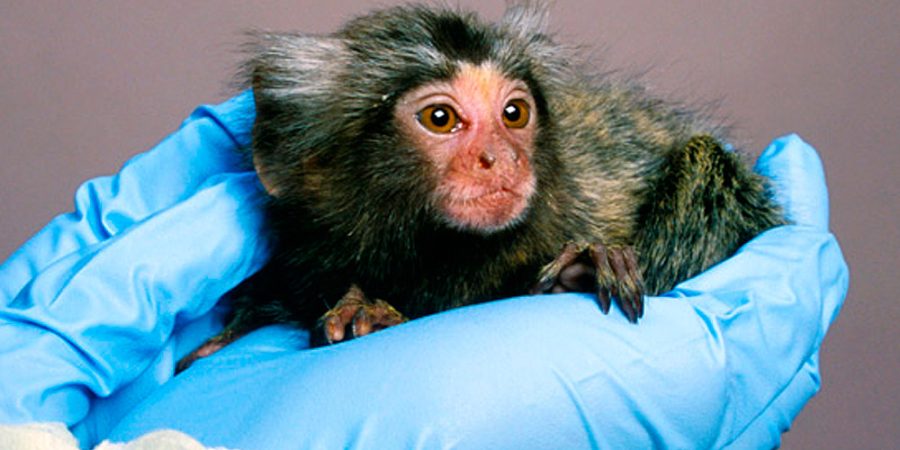
A macaque monkey stares pensively towards camera

7 facts about primate experiments in Australia.

Their 'uniquely human' qualities are costing them their freedom — and their lives.

Animals Australia

Animals Australia team

Last updated April 24, 2015

It may come as a surprise to many people that primates — most commonly macaques, baboons and marmosets — are not only bred for research in Australia but can be imported from overseas.

While exact numbers are hard to determine given the inconsistent, and often non-existent, reporting state to state, Animal Free Science Advocacy estimates hundreds of primates are confined in research labs each year.

They are caged, subjected to invasive procedures, and almost always killed once the experiment ends.

Read on to discover 7 truths about primate experiments in Australia and how you can help champion a kinder future for these animals.

This image contains content which some may find confronting

A monkey protecting his blind cage mate at a macaque breeding facility. in Laos
Image credit: Jo-Anne McArthur

1. It’s cruel

Non-human primates are self-aware, like us. And, just like us, they have an enormous capacity to suffer both physically, and psychologically.

When used in research, these incredible animals may be denied any semblance of a ‘normal’ life — they will be shipped from Australian breeding facilities or imported from breeding farms in Asia, like the one pictured above. They will be treated not as individuals, but as ‘experimental models’ — and may be the test subjects of many different experiments before they are ultimately killed.

These sensitive animals can be subjected to any number of distressing procedures during their lives, including the separation of mothers from their babies, invasive surgeries, being tied to restraint devices for hours on end, and being denied food and water.

Their ‘reward’, is to ultimately be killed when the experiments are over.

This image contains content which some may find confronting

A sad baby monkey behind a cage

2. It’s happening

Right now, right here — in our own backyard. Researchers are still killing primates — like baboons, macaques and marmosets. These highly intelligent and socially complex animals continue to be subjected to very invasive experiments — their suffering hidden from public scrutiny by a veil of secrecy.

This image contains content which some may find confronting

A sad primate in the gloved hand perhaps in a laboratory

3. It’s not about saving lives

Many people may assume animals are only used in research as a true ‘last resort’. Sadly, that isn’t the case. Although researchers must show that potential human benefits outweigh the harms to animals, Australia’s ethics system is permissive — and highly invasive, often lethal experiments on primates continue even when the likelihood of real human benefit is low. Animal-Free Science Advocacy has documented that these studies routinely cause significant suffering without delivering meaningful advances for human health.

This image contains content which some may find confronting

A sad monkey looking away behind a cage

4. You’re paying for it

Animal research is a multi-billion-dollar industry, encompassing the pharmaceutical and chemical industries, and university and government bodies. Most primates destined for experimental use are born into government-funded breeding facilities and transported to researchers whose studies are primarily funded through government research grants and, in some cases, public donations.

If you want to be confident that your donations are not supporting animal experiments, check out the Humane Charities List for a guide to health-related charities that do not fund or engage in animal research.

This image contains content which some may find confronting

A primate looks through the bars of a breeding facility

5. It’s bad science

Animal experiments repeatedly fail to predict how human bodies will respond to drugs or disease. Even with primates — our closest living relatives — key genetic, immune and physiological differences mean that results obtained in their bodies often do not translate to ours. Animal-Free Science Advocacy has highlighted that, time and again, primate research has failed to deliver the medical breakthroughs it promises, with claimed benefits to humans routinely overstated.

This image contains content which some may find confronting

A baboon bred for the research industry looks through the bars of a breeding facility

6. There’s no ‘retirement’ for ex-laboratory primates

While the National Health and Medical Research Council’s policy requires the long-term welfare of non-human primates to be considered, Australia has no sanctuaries or retirement facilities able to take primates once research ends. This means that primates used in Australian research facilities have no pathway to life outside a laboratory — they will spend their entire lives within the research system and are almost always killed at the end of their use.

This image contains content which some may find confronting

A macaque baby eats a leaf while looking curiously but shyly at the camera
Image credit: We Animals Media

7. There is a better way

We live in a truly remarkable age — where 3D printers can provide mobility to people (and animals!) who have lost their limbs, and research groups are well on their way to being able to custom-make body parts and organs in labs.

This is modern, human-relevant science that is better for people and animals.

Animal-free Science Advocacy has a wealth of information detailing alternatives to animal testing — cruelty-free options that showcase human ingenuity, and compassion, at their best.

Support modern science — without animal cruelty

If you’re for science that helps people without harming animals, here are some actions you can take to help non-human primates today:

Sign the pledge today

Many thanks to Animal Free Science Advocacy for sharing their research and information, and for their tireless work to end animal experimentation.