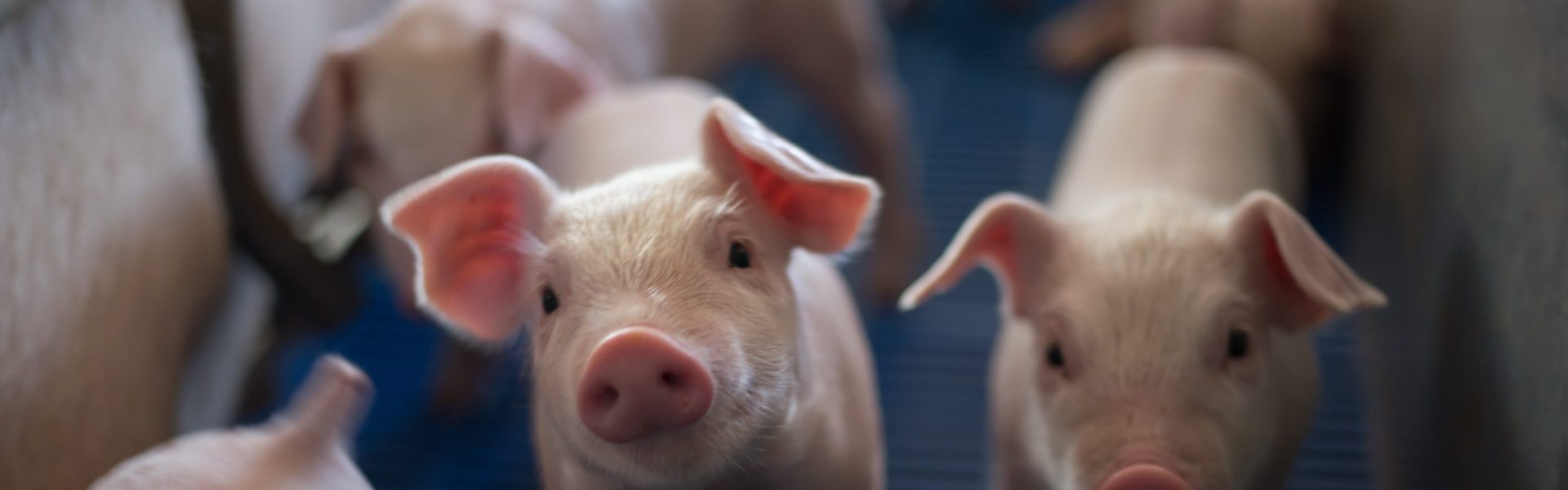
Two sweet pink piglets standing on a blue metal floor and looking up, other piglets in the background.

Who’s standing up for animals this Victorian election?

Animals in Victoria need change. Ahead of the election, candidates and parties have declared where they stand on critical animal welfare reforms.

Animals Australia

Animals Australia team

Last updated November 4, 2026

Victoria’s animal welfare laws are now 40 years old. Each year, ducks continue to be shot for ‘recreation’. Tens of thousands of native animals are killed under Victoria’s Government-issued kill permits. And greyhounds are dying on Victorian racing tracks. The need for change is clear.

So, in the lead-up to the 2026 state election, our friends at the Australian Alliance for Animals asked candidates: Where do you stand on critical animal welfare issues?

Six policy reforms were put to major parties and key independent candidates. Here’s how they responded:
This image contains content which some may find confronting

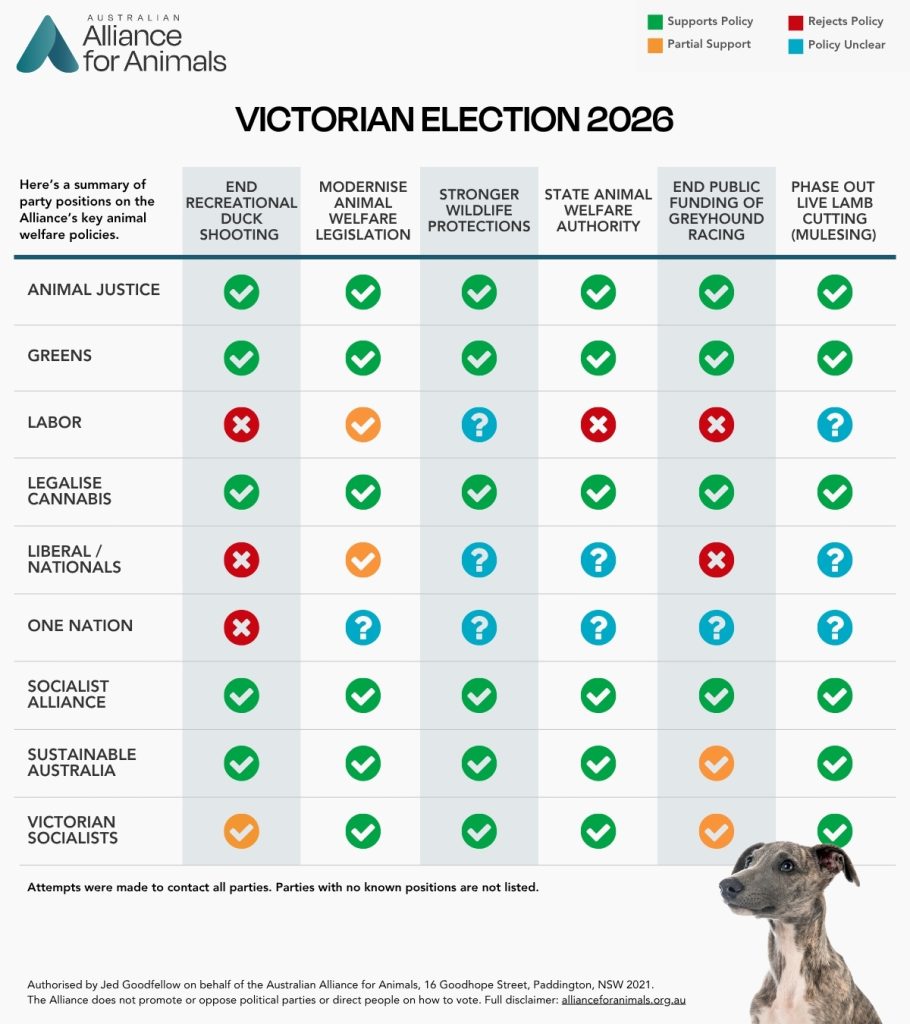
Australian Alliance for Animals’ 2026 Victorian Election Scorecard comparing nine political parties’ positions on six animal welfare policies: ending recreational duck shooting, modernising animal welfare legislation, strengthening wildlife protections, establishing a state animal welfare authority, ending public funding of greyhound racing, and phasing out live lamb cutting (mulesing). The Animal Justice Party, Greens, Legalise Cannabis and Socialist Alliance support all six policies, while Labor and the Liberal/Nationals reject or only partially support several policies, with other positions unclear.
This scorecard was produced by the Australian Alliance for Animals — a collaborative organisation of which Animals Australia is a founding member. Their remit is to progress legislative reform for animals in Australia and break through the regulatory capture that has impeded change for animals for far too long. 

Looking for more information?

You can find more details on each party’s response here.

READ THE PARTY RESPONSES

What does ‘partial support’ or an ‘amber tick’ mean?

It means the party or candidate support the intent of the policy, with some details yet to be determined. The Australian Alliance for Animals website has more information on the scorecard and how it was created.

Electorate-specific scorecards

Unique scorecards have been created for select electorates: Brighton, Footscray, Frankston, Kew , Macedon, Mill Park , Mornington, Northcote, Pakenham, Pascoe Vale, Prahran, Preston, Ringwood.

Don’t see your local electorate or candidates among these scorecards? 

Send an email to your local candidate to seek their views on animal welfare reform. You can find your local candidate here. Just click on your electorate, then scroll down to see who the candidates are —  you’ll find a link to their website and contact details.

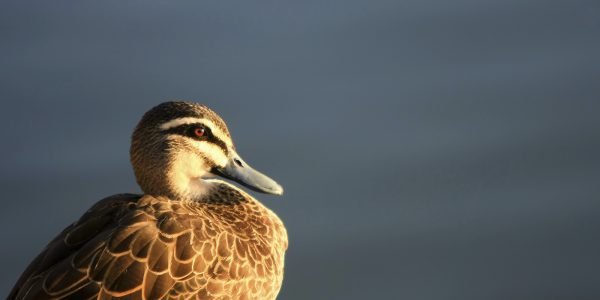
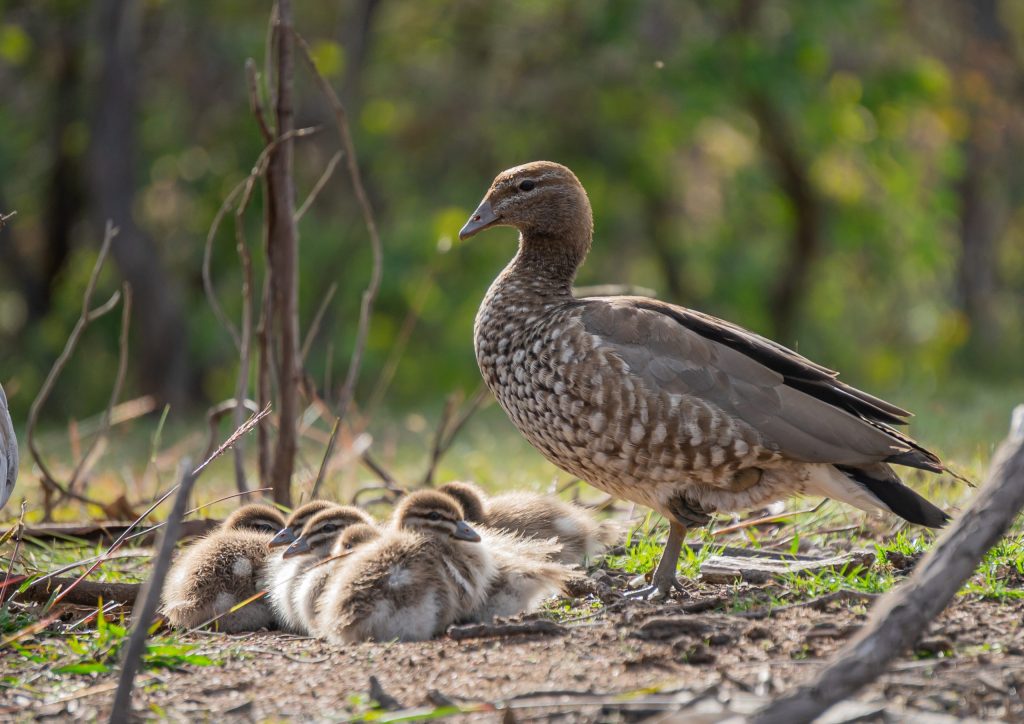
A wood duck with ducklings resting on the ground.
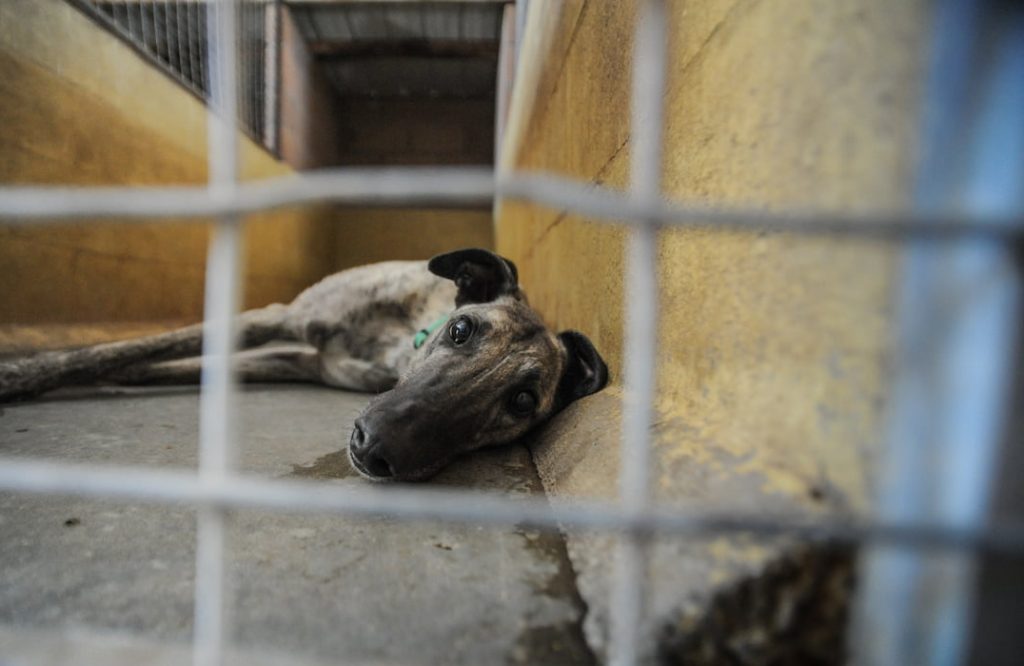
A greyhound, looking defeated, laying down in a barren kennel looking through the wire door.
Jo-Anne McArthur / We Animals

The six animal welfare policy asks

Introduce legislation to ban recreational duck and quail shooting consistent with the recommendation of the Legislative Council Committee on Victoria’s Recreational Native Bird Hunting Arrangements.

Expedite the passage of the Animal Care and Protection Bill to replace the Prevention of Cruelty to Animals Act 1986 (Vic) before the end of 2027, ensuring the explicit legal recognition of animal sentience.

Reforming the Wildlife Act 1975 (Vic) to:

(a)    Improve Authority to Control Wildlife (ATCW) accountability: Mandate substantive evidence of damage and the exhaustion of non-lethal options; require the publication of application decisions, reasons and kill data; and enforce strict welfare and competency standards; and

(b)    Enhance emergency responses: Integrate qualified NGO disaster response wildlife teams into incident control centres and grant them fireground access equivalent to other emergency response professionals.

Strengthen animal welfare enforcement arrangements by recognising Animal Welfare Victoria as an independent statutory body under the Prevention of Cruelty to Animals Act 1986 (Vic) with responsibility for administering the Act, and with an appropriate budget allocation to ensure adequate resourcing. (Note: this would not replace RSPCA inspectors – they would report to the Authority).

Commit to phasing out the public funding of greyhound racing in the next parliamentary term by ceasing distribution of the Point of Consumption Tax towards greyhound racing, ending all greyhound-related grants from the Victorian Racing Industry Fund, stopping one-off payments and by mandating that no funds are directed towards the greyhound code from industry funding agreements.

Introduce legislation within the next parliamentary term to commence a phase out of live lamb cutting (mulesing), require multi-modal pain relief while the practice continues, and promote the breeding of fly-strike-resistant sheep.

A kinder Victoria for animals

Creating change for animals through legislative progress can be extremely slow. But it is far from meaningless. Progress largely comes from the year-round work of compassionate Australians, keeping the issues animals face squarely on the political agenda. These tireless efforts have helped secure a legislated end date of May 2028 for Australia’s live sheep exports by sea, and have led state ministers to agree to phase out the archaic practice of confining hens to battery cages by 2036.

To keep the momentum for meaningful change, we don’t have to wait for election cycles to roll around — we can each cast a vote for kindness every day of the year. Check out our 5 Minute Guide to Compassionate Living to see the small but powerful ways you can be a hero for animals.

Authorised by G Oogjes, Animals Australia, 37 O’Connell Street, North Melbourne, VIC 3051